Researchers at the ICAM have developed a mechanism-based model to predict high temperature hydrogen attack (HTHA), a process that weakens steel and can lead to catastrophic equipment failure in hydrogen-rich environments. By providing experimental evidence of crack formation and revising the industry’s empirical Nelson curves (safety standard guidelines), this work enables more accurate material selection and safer operating conditions for refineries and hydrogen processing facilities. The model accounts for stress, internal pressure, and microstructural changes, reducing risk and improving reliability. This research helps ensure existing and new equipment can handle diverse applications, such as processing new feedstocks and hydrogen production, storage, and conversion.
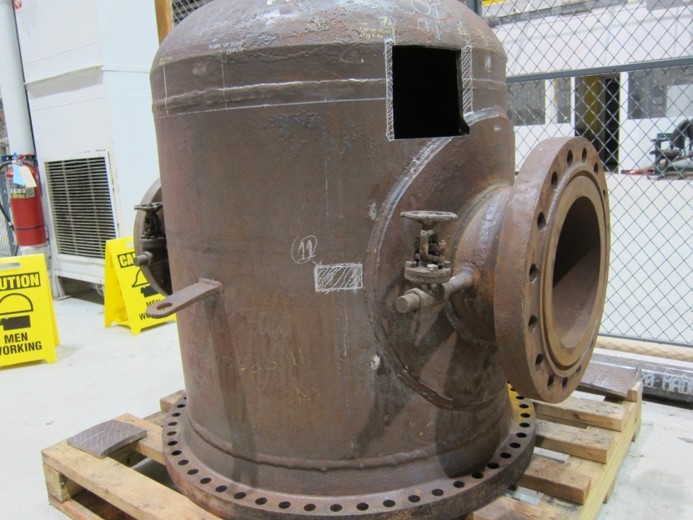
A bp depentanizer reboiler that was taken out of service due to high temperature hydrogen attack (HTHA), and studied in this research.
“Nelson-curve design against hydrogen attack over the past 75 years has been entirely empirical. A new chemomechanics-based fitness-for-service approach has been developed that is as easy to use as the Nelson diagram but accounts for microstructure, deformation, failure mechanisms, and structural loads.”
Professor Petros Sofronis, University of Illinois Urbana-Champaign