Fischer Tropsch synthesis provides an effective route for converting sustainable feedstocks including biomass and municipal solid waste to high value products such as sustainable aviation fuel (SAF). Expert bp Mentors who are directly involved in implementation of this technology at bp are working with academic experts in advanced transmission electron microscopy (TEM), X-ray photoelectron spectroscopy (XPS) and diffuse reflectance infrared fourier transform spectroscopy (DRIFTS) to characterise structural and chemical changes in bp’s propriety catalyst during the activation step and under operational conditions. The results are correlated to theoretical calculations with the aim of extending catalytic performance and operational lifetimes.
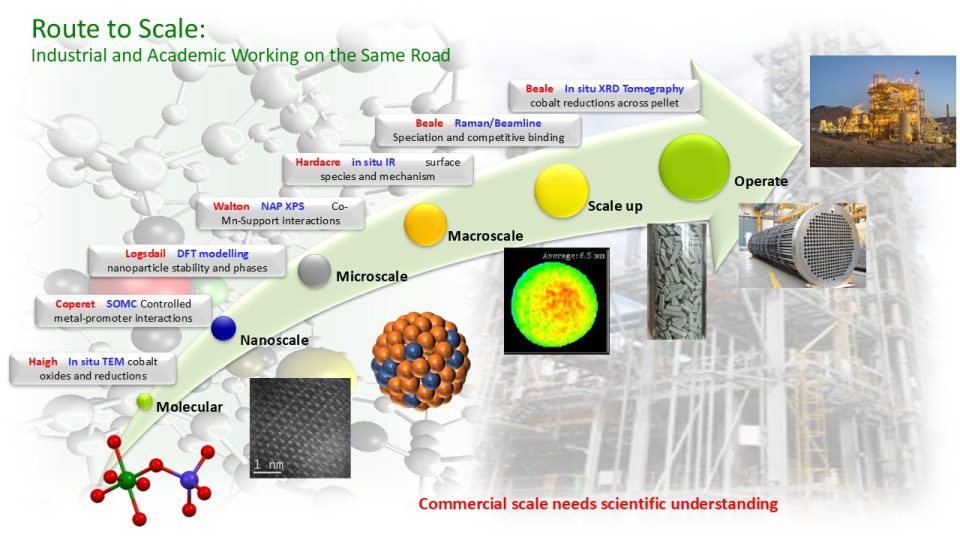
“Our ongoing research in Fischer-Tropsch technology development is vital, it brings together a unique set of skills to address key questions in the technology process. It leverages capability which is not available inside bp and uses cutting edge and complementary techniques that challenge our understanding of the process conditions. One of the major advantages of this programme is the breadth of techniques that we bring together including microscopy, spectroscopy and computational modelling which we can use to target a specific challenge. bp Mentors are strongly engaged in the meetings to challenge the science and bring learning and value into bp.”
Dr James Paterson, bp Mentor and Senior Manager, Physical Sciences UK, Applied Sciences, bp